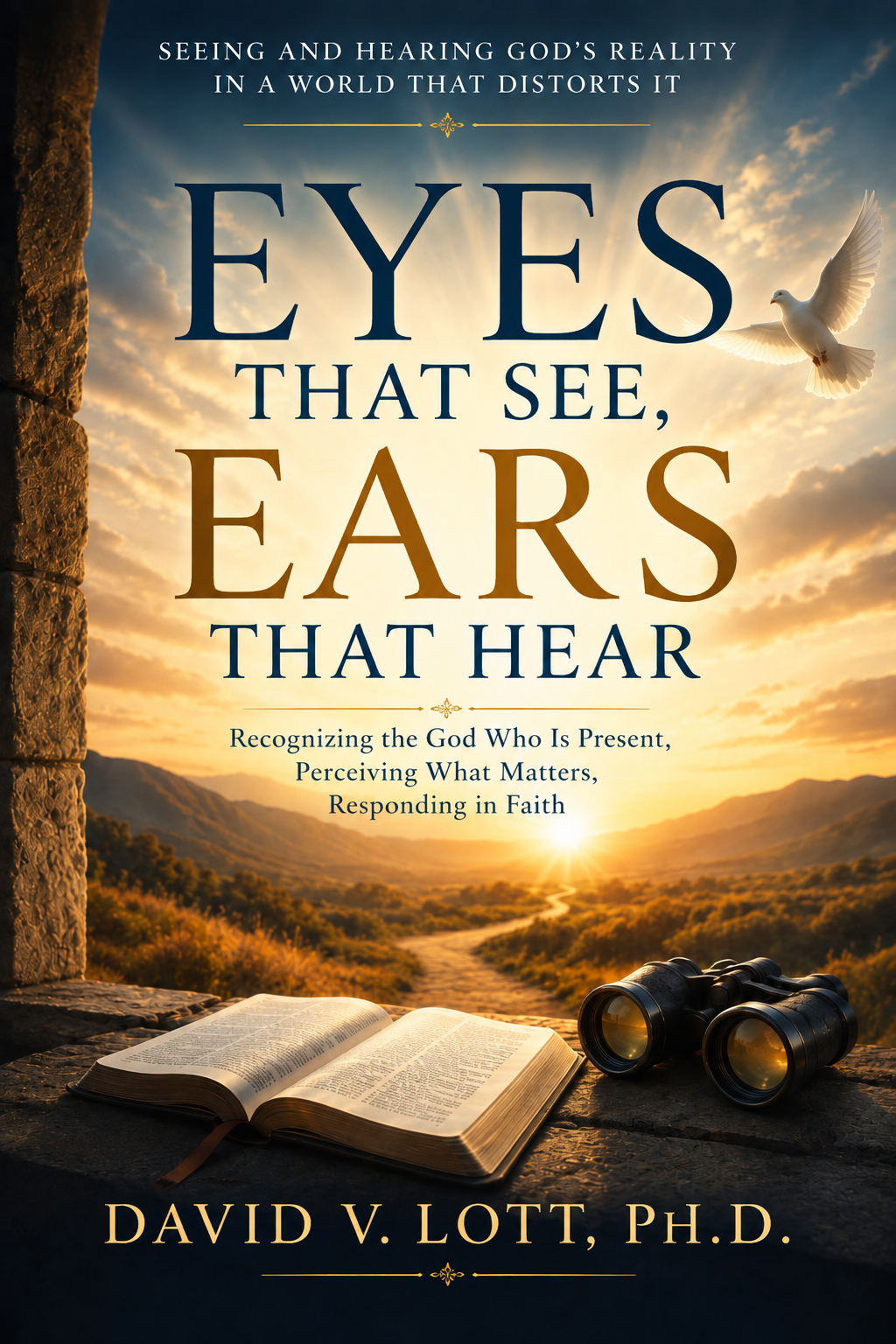
Spiritual Perception • Worship • Idolatry • Restoration
Eyes To See, Ears To Hear
How Worship Shapes What You Perceive, Why Idols Are Making You Blind, and How Beholding Christ Restores Your Ability to Walk With God
Scripture repeatedly describes people who possess functioning eyes yet fail to see, hear words yet fail to understand, and stand in the presence of divine reality without recognizing what is before them. The problem is deeper than physical sight or hearing. It concerns the heart—the inner person through which we receive, interpret, trust, and respond to what God has revealed.
Eyes To See, Ears To Hear traces this theme across the biblical story, beginning with humanity created to know and reflect God, moving through the distortion introduced in Eden and the deforming power of idolatry, and finally arriving at the restoration of the image-bearer through Christ. Along the way, the ancient problem of idols becomes strikingly contemporary as the book examines the modern forces competing for our attention, trust, desire, and worship.
The central question is not simply What are you looking at? It is more searching:
What has been teaching you to see?
The Invisible Reality
Something Can Be Present Before You Recognize It
Jacob awakened from his dream at Bethel with a startling realization: “Surely the LORD is in this place, and I did not know it” (Genesis 28:16). God had not suddenly arrived when Jacob became aware of Him. Divine reality preceded human recognition.
That pattern appears repeatedly throughout Scripture. Hagar reaches despair before her eyes are opened to provision already nearby. Balaam cannot see what his donkey sees. Elisha’s servant sees the enemy surrounding the city but cannot yet see the greater heavenly reality surrounding the enemy. The disciples on the road to Emmaus walk beside the risen Christ while believing that the One in whom they had placed their Hope was gone.
These accounts expose an important distinction. Something does not become real because we perceive it, nor does it cease to be real because we fail to perceive it. Human perception can be accurate, partial, distorted, or simply unaware. Reality does not rearrange itself according to the limits of our present vision.
Reality precedes perception. Grace precedes recognition.
The Original Design
The Biblical Story Does Not Begin With Blindness
“The hearing ear and the seeing eye, the LORD has made both of them” (Proverbs 20:12). Before Scripture describes ears that refuse to hear or eyes that fail to see, it introduces the God who created both.
Humanity awakens within a reality it did not create. God speaks before human beings hear Him. Creation exists before human eyes behold it. Humanity is created in God’s image and given the extraordinary capacity to know the Creator, receive His word, respond to His revelation, and reflect His character within creation.
Biblical seeing therefore extends beyond eyesight, just as biblical hearing extends beyond the reception of sound. Scripture moves repeatedly from the eyes and ears toward the heart—the whole inner person that thinks, desires, remembers, evaluates, trusts, and responds.
Spiritual perception is not a mystical ability possessed by an elite group of believers. It is the God-enabled capacity to recognize and receive divine reality on God’s terms and respond faithfully to what He has revealed.
Eden
Before Sin Changed Human Behavior, It Changed Human Perception
The serpent’s first strategy in Genesis 3 is not to persuade Eve that God does not exist. It is to alter how she perceives the God who does exist.
The garden is filled with divine generosity, yet the serpent narrows Eve’s attention to the single restriction. God’s provision recedes into the background while the forbidden tree occupies the center of her vision. Nothing about God has changed. Nothing about the garden has changed. What changes is the interpretive frame through which Eve sees them.
The temptation is then presented as enlightenment: “your eyes will be opened.” Yet when Adam and Eve’s eyes are opened, the first thing they perceive is their nakedness and shame. Humanity reaches for greater sight apart from trust in God and immediately begins hiding from Him.
The tragedy of Eden is therefore not merely that humanity broke a command. The creature began trusting its own perception above the word and character of the Creator.
The decisive question is not merely what we see, but which word determines what we see.
The Deforming Power of Idols
Worship Forms the Worshiper
Psalm 115 describes idols with mouths that cannot speak, eyes that cannot see, ears that cannot hear, hands that cannot feel, and feet that cannot walk. The description would already constitute a devastating critique of idolatry, but the Psalm goes further: those who make and trust such idols become like them.
That statement reveals one of the central theological claims of Eyes To See, Ears To Hear. Worship does not merely reveal what we value. Worship forms us. What we repeatedly trust, treasure, fear, desire, and look toward exercises formative power over the person we are becoming.
Humanity was created in the image of the living God. Idolatry reverses that order. The image-bearer becomes an image-maker and then bows before the image he has made. As worship is redirected away from the living God toward something incapable of giving life, the worshiper begins to reflect the lifeless object of his trust.
False worship therefore does more than violate a religious command. It deforms the image-bearer.
Modern Idolatry
The Idols Have Changed Their Appearance, Not Their Power
Modern people rarely bow before carved statues, which can make idolatry seem like a problem belonging to another age. Yet the underlying movement of the heart remains remarkably familiar.
Modern idols live in our pockets, inhabit our ambitions, fuel our anxieties, and quietly influence our definition of the good life. Money, approval, control, comfort, status, security, and countless other created goods can become objects of ultimate trust without ever being called gods.
The danger is precisely that they appear ordinary. A good thing becomes spiritually deforming when it assumes a place in our trust that belongs to God alone.
What do I look toward for security?
What do I fear losing?
Whose approval determines my sense of worth?
What promise am I trusting to give me the life I believe I need?
What has been teaching me to see?
What Has Your Eyes?
Attention Is One of the Great Spiritual Battlegrounds of Modern Life
We live within an economy built upon capturing and retaining human attention. Screens, algorithms, advertising, entertainment, outrage, fear, comparison, desire, and constant notification compete for the same finite field of vision.
Attention is not automatically worship. Yet worship necessarily involves attention. What repeatedly occupies the heart begins to form the person, and what forms the person eventually shapes what that person is able—or willing—to perceive.
The spiritual problem is therefore more subtle than merely spending too much time with technology. The deeper question is whether our habits of attention are training us to receive the world according to God’s revelation or according to the endless succession of voices demanding our gaze.
Spiritual formation in such a world requires deliberate attention: not passive attention that drifts wherever the current carries it, but protected attention that repeatedly chooses the One necessary thing over the many things competing for the same space.
The question is not only whether Scripture was present. The question is whether we were present to Scripture.
Christ
The Answer to the Distorted Image-Bearer Is the True Image
Scripture’s diagnosis of distorted perception never stands alone. The biblical story moves toward restoration.
Paul calls Christ “the image of the invisible God” (Colossians 1:15). Where humanity’s image-bearing vocation has been damaged by false worship, Christ reveals humanity as it was meant to exist in perfect relationship with the Father. He does not merely provide better information to people who cannot see. He is Himself the true Image toward whom the damaged image-bearer must be restored.
This gives Christian transformation a profoundly Christ-centered direction. Redemption is not simply movement away from undesirable behavior. It is restoration toward genuine humanity in Christ.
The Spirit opens eyes, unstops ears, softens hardened hearts, and through the Word continually reorients believers toward the One they were created to reflect.
The Restoration of the Image
What We Behold, We Begin to Resemble
Second Corinthians 3:18 provides the redemptive counterpart to Psalm 115. False worship deforms the worshiper toward lifeless idols; beholding the glory of the Lord becomes the context in which the Spirit transforms believers toward the image of Christ.
The same theological principle therefore moves in two directions. Worship forms the worshiper. The question is what we are worshiping and therefore what we are becoming.
This transformation is neither instantaneous nor self-produced. The disciples themselves learned to see in stages. Believers remain dependent upon grace. Yet the transformation is genuine: from one degree of glory to another, the damaged image-bearer is being restored toward the true Image.
This changes the purpose of Bible reading as well. Scripture is not given merely to increase our storehouse of religious information. Through the Word we encounter the Christ Scripture reveals, and in beholding Him the Spirit forms us toward His likeness.
Emmaus
Hope Was Walking Beside Them Before They Recognized Him
The disciples traveling toward Emmaus provide one of Scripture’s most powerful pictures of limited perception. They had seen Jesus crucified, and what they saw appeared to destroy what they had hoped. Their language places Hope in the past tense: “we were hoping.”
Yet while they interpreted the future through the apparent finality of the cross, the risen Christ was already walking beside them.
Before their eyes were opened, however, the Scriptures were opened. Christ taught them to reinterpret what they had seen through the larger story of what God had revealed. Only then, in the breaking of bread, did recognition come.
Recognition changed their direction. The road that had carried them away from Jerusalem in grief now carried them back as witnesses. The circumstances behind them had not changed. Their perception of those circumstances had.
The One in whom they had hoped had been beside them all along. Recognition turned the past tense of Hope into the present tense of testimony.
A Prayer for Believers
You Never Outgrow Your Need for God to Open Your Eyes
Paul’s prayer in Ephesians 1 is addressed to people who already believe. He prays that the eyes of their hearts may be enlightened so that they may know the Hope of God’s calling, the riches of His inheritance, and the greatness of His power toward those who believe.
That prayer guards Christian spiritual perception from arrogance. Conversion does not make us independent perceivers who now possess sufficient clarity on our own. The Christian life remains grace-dependent from beginning to end.
Spiritual maturity therefore does not finally say, “Now I see enough.” It continues asking God to illuminate what He has revealed, correct what has been distorted, expose what has captured our trust, and teach us to see Christ more clearly.
Spiritual sight begins with dependence and matures in humility.
The Canonical Arc
From the Garden to the Face of God
Eyes To See, Ears To Hear follows a single theological movement across the canon of Scripture. The story begins with creatures made to see, hear, know, and reflect their Creator. It passes through the distorted vision of Eden, the deforming power of idols, prophetic warnings concerning eyes that refuse to see and ears that refuse to hear, hardened hearts, and humanity’s continuing tendency to trust created things rather than the Creator.
The Gospels then introduce the One who opens blind eyes and reveals Himself as the true Image. The risen Christ restores Hope to disciples whose interpretation of reality had collapsed. Paul describes enlightened hearts and believers transformed as they behold the glory of the Lord.
Finally, Scripture carries the restored image-bearer toward the destination that has quietly governed the entire journey.
Created Sight
↓Distorted Sight
↓Idolatrous Sight
↓Hardened Sight
↓Opened Eyes
↓Beholding Christ
↓Transformed Sight
↓They Shall See His Face
The Bible begins with humanity hiding from God in a garden. It ends with redeemed humanity standing before His face.
Questions the Book Explores
What Has Been Teaching You to See?
- 01
What does Scripture mean when it describes people who have eyes but cannot see and ears but cannot hear?
- 02
How can our perception of God become distorted even when the truth about God has not changed?
- 03
Why does Scripture say that those who worship idols eventually become like them?
- 04
What are the functional idols of modern life, and how do they shape the way we perceive God, ourselves, and the world?
- 05
How are the technologies and habits competing for our attention forming our spiritual perception?
- 06
Why is Christ described as the true Image, and what does that mean for the restoration of humanity?
- 07
What does Paul mean when he describes believers being transformed as they behold the glory of the Lord?
- 08
How does the Emmaus account show that Hope can be present even when our interpretation of circumstances tells us otherwise?
- 09
Why does Paul pray for the enlightened eyes of people who already believe?
- 10
How does the promise that they shall see His face complete the Bible’s story of seeing, hearing, worship, and restoration?
The Biblical Foundation
Seeing, Hearing, Worship, and Restoration Across Scripture
Creation & Distortion
- Genesis 1:26–27
- Genesis 3:1–13
- Genesis 28:10–17
- Proverbs 20:12
- Psalm 115:4–8
Blindness & Recognition
- Isaiah 6:9–10
- Ezekiel 12:2
- Mark 8:17–25
- Luke 24:13–35
- John 9
Restoration & Beholding
- Colossians 1:15
- 2 Corinthians 3:16–18
- 2 Corinthians 4:6
- Ephesians 1:17–18
- Revelation 22:4
The Essence of the Book
"Worship forms the worshiper. What we behold, we begin to resemble."
False worship deforms the image-bearer because we gradually become like the objects in which we place ultimate trust. The biblical answer is therefore not merely better behavior or greater religious information. It is restored worship. Christ is the true Image, and as believers behold His glory through the Word, the Spirit restores what idolatry has distorted. The goal is not spiritual perception for its own sake, but communion with God and a life increasingly formed into the likeness of Christ.
Go Deeper
Eyes To See, Ears To Hear — Teaching Study
The themes developed in Eyes To See, Ears To Hear are also available in a teaching study designed for personal study, Sunday School, small groups, and discipleship settings. The study explores the biblical contrast between eyes that merely look and eyes that truly perceive, the deforming effect of idolatry, the relationship between worship and spiritual formation, and the restoration of spiritual sight through Christ.
Hope and Perception
What We Cannot Yet See Is Not Therefore Absent
Hope remains deliberately understated through much of the book because the central subject is spiritual perception. Yet the two themes eventually converge.
Hagar cannot initially see the provision already present. Elisha’s servant cannot see the heavenly army. The disciples at Emmaus cannot recognize the risen Christ walking beside them. In each case, the limits of human perception do not establish the limits of divine reality.
Christian Hope therefore does not depend upon our ability to master the future or explain every present circumstance. It rests upon the character and promises of the One to whom the future belongs. We may faithfully confess, “I cannot see from here,” without converting that limitation into the much larger claim that God is absent or that His promises have failed.
Paul consequently prays that the eyes of believers’ hearts will be enlightened to know the Hope of God’s calling. Hope is not an exercise in imagining what cannot be seen. It is confidence in divine reality grounded in the God who has revealed Himself.
Partial sight is not permanent sight. The process remains incomplete, but the destination is secure.
The End of Partial Sight
They Shall See His Face.
The biblical story ends where the argument of Eyes To See, Ears To Hear has been moving all along. Revelation describes the servants of God standing before the throne of God and the Lamb. The curse is gone. Darkness is gone. The long age of partial sight reaches its conclusion.
They shall see His face (Revelation 22:4).
Humanity once hid from the presence of God among the trees of Eden. Redeemed humanity will finally stand before His face. Between those two scenes lies the entire drama of spiritual perception: created sight, distorted sight, resistant sight, opened sight, transformed sight, partial sight, and finally sight fulfilled in unobstructed communion with the living God.
This is why the restoration of sight matters. The ultimate goal is not becoming unusually perceptive, intellectually sophisticated, or spiritually impressive.
The goal is communion.
About the Book
Eyes To See, Ears To Hear
How Worship Shapes What You Perceive, Why Idols Are Making You Blind, and How Beholding Christ Restores Your Ability to Walk With God
David V. Lott, Ph.D.
Eyes To See, Ears To Hear traces the biblical theology of spiritual perception from creation to new creation, asking why Scripture so frequently describes people who possess eyes yet fail to see and ears yet fail to hear. Beginning with humanity’s vocation as image-bearers, the book examines the distortion introduced in Eden, the deforming power of idolatry, the modern economy of attention, the hardening of the heart, and the subtle ways our objects of trust shape what we are capable of perceiving. The biblical answer ultimately leads to Christ, the true Image. As believers behold Him through the Word, the Spirit restores the damaged image-bearer toward His likeness, carrying the story toward its final promise: they shall see His face.
Coming Soon on Amazon