BIBLICAL & HISTORICAL STUDY
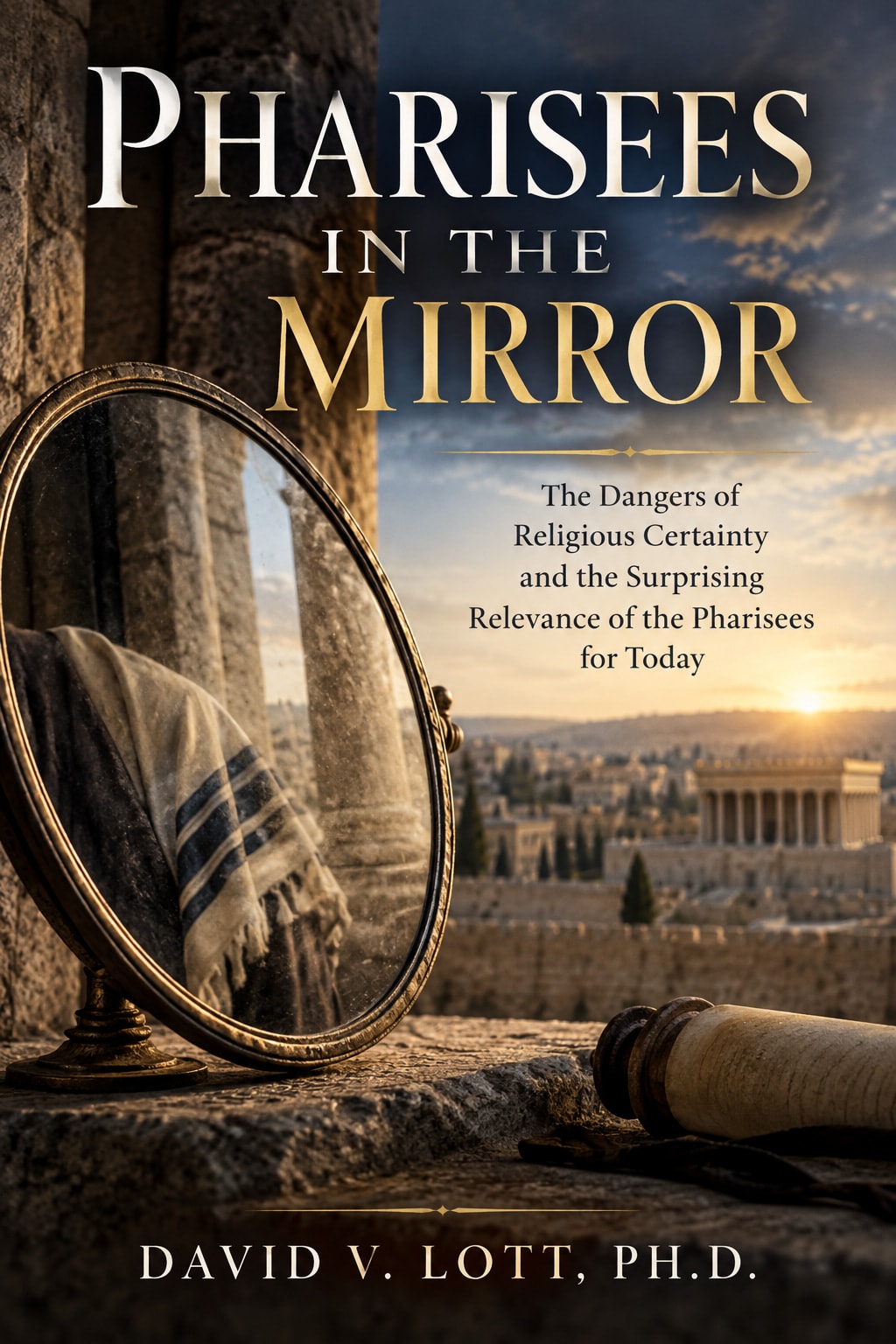
The Pharisees in the Mirror
The Dangers of Religious Certainty and the Surprising Relevance of the Pharisees for Today
David V. Lott, Ph.D.
The Pharisees have become convenient villains in the Christian imagination. Yet their story is more complicated—and far more relevant—than the caricature suggests. They were serious about Scripture, committed to holiness, and determined to preserve faithfulness to God in a changing world. How, then, did such religious devotion become vulnerable to the spiritual blindness Jesus confronted?
The Pharisees in the Mirror examines their historical development, their place within Second Temple Judaism, and their encounters with Jesus before turning the question toward us. The danger of Phariseeism did not disappear with the first century. Whenever devotion to God becomes confidence in our own religious certainty, the mirror deserves another look.
VIEW ON AMAZON →View on Goodreads→Paperback | ISBN 979-8176643480
LOOKING INTO THE MIRROR
Before We Condemn the Pharisees
It is easy to read the Gospels with the assumption that we would have recognized Jesus while the Pharisees somehow failed to see what should have been obvious. That assumption allows us to stand safely outside the story.
This book takes a different approach. Before using "Pharisee" as a synonym for hypocrisy, legalism, or religious pride, we need to understand who the Pharisees actually were, how their movement developed, what they were attempting to preserve, and why many of their convictions would have appeared both reasonable and faithful within their historical setting.
Only then are we prepared to ask the more uncomfortable question: Are the tendencies Jesus confronted in them capable of appearing in us?
“The Pharisees are easy to condemn when they remain safely in the first century. They become considerably more uncomfortable when we recognize them in the mirror.”
— David V. Lott, Ph.D.
HISTORY MATTERS
The World That Produced the Pharisees
The Pharisees did not suddenly appear on the pages of the New Testament. Their story belongs to the larger history of Israel—the trauma of exile, the restoration of Jewish life, the pressures of foreign rule, the struggle to preserve covenant identity, and the religious developments of the Second Temple period.
Understanding that history changes the way their encounters with Jesus are read. Practices that can appear arbitrary when removed from their setting often arose from serious attempts to protect Israel's faithfulness to God. The tragedy was not that devotion itself was wrong, but that religious systems intended to protect faithfulness could eventually become capable of obscuring the very One to whom that faithfulness was supposed to lead.
FROM HISTORY TO DISCIPLESHIP
When Religious Certainty Becomes Spiritual Blindness
The central concern of this book is larger than the historical Pharisees. Religious communities naturally develop traditions, interpretations, boundaries, and systems intended to preserve what they believe to be true. Many of those structures begin for good reasons. The danger arises when the structures themselves become so closely identified with faithfulness to God that questioning them begins to feel like questioning God Himself.
Jesus repeatedly forced His hearers to distinguish between devotion to God and devotion to the religious structures built around Him. That distinction remains necessary. The question is not merely whether the Pharisees could become spiritually blind while sincerely believing they were defending truth. The question is whether we can do the same.
INSIDE THE BOOK
Scripture, History, and the Mirror
The Historical Roots of the Pharisees
Trace the circumstances that helped shape the movement and the religious world encountered in the Gospels.
The World of Second Temple Judaism
Place the Pharisees among the competing movements, expectations, and theological concerns of first-century Judaism.
Jesus and the Pharisees
Examine their encounters without reducing either the historical setting or Jesus' criticisms to caricature.
Tradition, Scripture, and Authority
Consider what happens when interpretations designed to protect Scripture begin functioning with the authority of Scripture.
The Danger of Religious Certainty
Explore how sincere conviction can become resistant to correction and eventually incapable of recognizing uncomfortable truth.
The Pharisee in the Mirror
Turn the historical study toward contemporary Christian discipleship and ask where the same tendencies may still appear.
HOW THE BOOK READS SCRIPTURE
Understanding Their World Before Judging Their Actions
The Pharisees in the Mirror approaches the biblical text historically without allowing history to replace Scripture. Second Temple Jewish literature, historical evidence, and cultural background help reconstruct the world in which the New Testament was written, but the canonical Scriptures remain the theological authority of the study.
“Respect the words. Understand their world. Establish what the text meant there. Then ask how its truth speaks here.”
— David V. Lott, Ph.D.
The Pharisees in the Mirror
The most important question raised by the Pharisees may not be why they failed to recognize what God was doing in their generation. It may be whether we are certain that we would recognize Him in ours.
VIEW THE BOOK ON AMAZON →View on Goodreads→ISBN 979-8176643480