Family · Faith · Stewardship
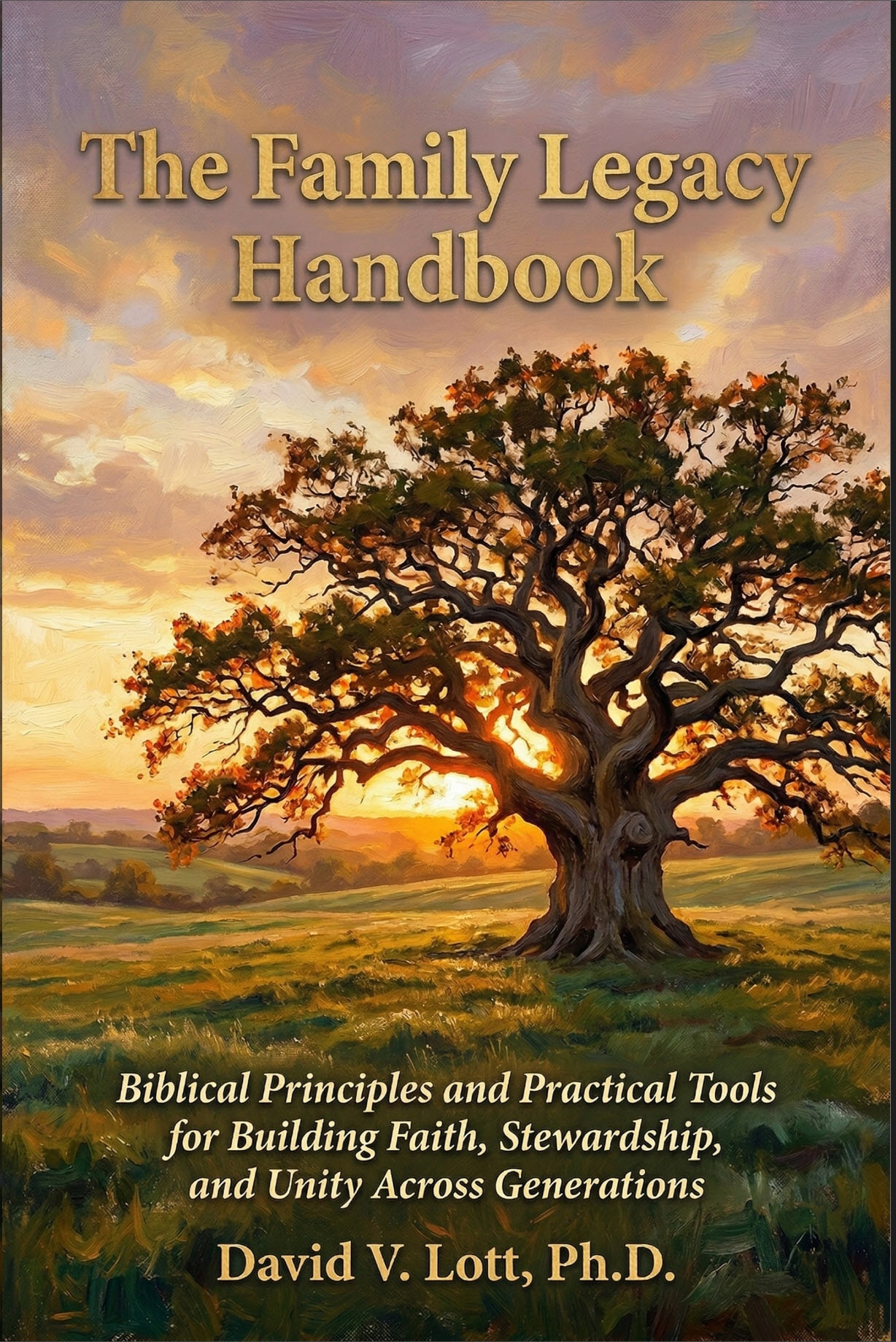
The Family Legacy Handbook
Biblical Principles and Practical Tools for Building Faith, Stewardship, and Unity Across Generations
Every family leaves a legacy. The more important question is whether that legacy is being built intentionally.
A meaningful family legacy consists of far more than the assets eventually transferred from one generation to another. It includes the faith that shapes a family, the values by which decisions are made, the wisdom accumulated through years of experience, the relationships that hold generations together, and the understanding of stewardship that determines how God-given resources will be used.
The Family Legacy Handbook brings biblical principles and practical tools together to help families think intentionally about what they are building, what they are teaching, and what they hope future generations will carry forward.
The Central Question
What Are We Actually Passing to the Next Generation?
When families speak about legacy, the conversation often begins with inheritance. Houses, investments, businesses, land, personal possessions, and financial accounts eventually pass from one generation to another, making responsible planning an important part of family stewardship.
Scripture, however, gives the idea of inheritance a much broader horizon. Parents and grandparents also transmit beliefs, priorities, habits, attitudes toward money, patterns of relationships, family stories, and an understanding of what ultimately matters. Some of these things are taught intentionally, while others are absorbed simply by watching how previous generations live.
A biblical approach to legacy therefore asks a larger question than how property will eventually be distributed. It asks what kind of family we are forming and what we are placing into the hands and hearts of those who come after us.
The most important inheritance we leave may never appear on an estate inventory.
The First Foundation
Faith Must Become More Than a Family Tradition
Scripture repeatedly places responsibility upon one generation to make the works and truth of God known to the next. Deuteronomy describes God's words being woven into the ordinary rhythms of family life, while the Psalms speak of one generation declaring His works to another. Paul later reminds Timothy of the sincere faith that was present in his grandmother Lois and his mother Eunice before becoming evident in him.
These passages describe something deeper than maintaining a religious family identity. Biblical faith cannot simply be inherited in the way property is inherited. Each generation must encounter the truth of God for itself, yet previous generations have the privilege and responsibility of creating an environment in which that truth is taught, discussed, demonstrated, and remembered.
The goal of generational discipleship is therefore not to force descendants into a predetermined mold, but to faithfully place before them a coherent witness to the character of God and the truth of Scripture.
A family cannot manufacture faith in the next generation, but it can faithfully prepare the soil in which that faith is invited to grow.
A Different View of Resources
What We Possess Is Entrusted Before It Is Owned
The biblical doctrine of stewardship changes the way a family thinks about wealth, possessions, opportunity, ability, and influence. Instead of beginning with the assumption that everything we possess exists primarily for our own use, stewardship begins by recognizing God as the ultimate owner and ourselves as those temporarily entrusted with His resources.
That perspective has important implications for legacy. The question is no longer simply how much wealth can be accumulated or transferred. Families must also consider what those resources are intended to accomplish, what values accompany them, and whether the next generation has been prepared to manage them wisely.
Wealth without wisdom can become destructive. Resources accompanied by character, gratitude, responsibility, generosity, and a clear understanding of stewardship can become instruments through which one generation equips another to serve purposes larger than itself.
The objective is not merely to leave resources behind, but to prepare people capable of stewarding whatever has been entrusted to them.
Two Different Questions
What Will They Receive—and What Will They Remember?
An inheritance consists primarily of what one generation leaves to another. A legacy encompasses what one generation builds into another.
The distinction matters because families can devote enormous attention to preparing assets for their heirs while giving comparatively little attention to preparing their heirs for those assets. Estate documents may transfer property efficiently, but they cannot transfer wisdom, character, gratitude, family purpose, or a biblical understanding of stewardship.
A healthy legacy therefore develops on two tracks at the same time. Families plan responsibly for the resources they possess while intentionally cultivating the people and relationships through which those resources will eventually pass.
Inheritance
What we leave to the next generation: property, financial resources, possessions, businesses, opportunities, and other tangible assets.
Legacy
What we build into the next generation: faith, wisdom, character, family stories, values, relationships, stewardship, generosity, and a sense of responsibility.
A thoughtful family prepares both the inheritance and the inheritor.
Remembering
A Family That Forgets Its Story Loses Part of Its Identity
Scripture frequently connects faith with remembrance. Israel was repeatedly instructed to remember what God had done and to tell those events to succeeding generations. Memorials were established so that children would ask questions, giving parents an opportunity to explain the faithfulness of God within the history of His people.
Families possess stories as well. They remember seasons of hardship and provision, mistakes and recovery, unexpected opportunities, sacrifices made by previous generations, prayers that were answered, lessons learned through failure, and moments when God's faithfulness became particularly evident.
When those stories disappear, later generations may inherit the results of earlier sacrifice without understanding what produced them. Preserving family history is therefore not an exercise in nostalgia. Properly understood, it becomes a means of transmitting wisdom, gratitude, perspective, and identity.
Tell the next generation not only what the family possesses, but how the family arrived where it is and what was learned along the way.
Relationships Across Generations
A Legacy Cannot Remain Healthy Where Relationships Collapse
Families inevitably change as children become adults, marriages bring new members into the family, grandchildren arrive, careers and geography pull people in different directions, and individual personalities and priorities become more pronounced. Unity across generations therefore cannot be assumed simply because people share a last name.
Healthy family relationships require communication, humility, forgiveness, appropriate boundaries, respect for adult children, and a willingness to allow succeeding generations to assume genuine responsibility. Parents who spent years leading their families eventually face the different task of releasing control while remaining available as sources of wisdom and encouragement.
Family unity does not require uniformity. Adult children will make choices their parents would not make, and different households will develop their own traditions and priorities. The objective is not control across generations but relationships strong enough to accommodate differences while preserving love, respect, and shared commitments.
The strength of a family legacy is measured not only by what survives financially, but by whether the family still wants to gather when no one is required to be there.
Looking Beyond the Family
A Legacy Becomes Larger When It Learns to Give
A biblical understanding of stewardship prevents family legacy from becoming merely an exercise in preserving wealth within a bloodline. God's provision creates opportunities not only to care responsibly for one's family but also to serve others, strengthen the Church, relieve need, support worthy work, and participate generously in purposes that extend beyond ourselves.
Children and grandchildren learn generosity most effectively when they see it practiced. When younger generations participate in decisions about giving, service, and philanthropy, they begin to understand that resources carry responsibilities as well as privileges.
A family legacy shaped by generosity asks not merely, "How much can we preserve?" but also, "What good can God accomplish through what He has entrusted to us?"
The Third Generation
Influence Does Not End When Parenting Does
Grandparenthood creates a distinctive opportunity within generational discipleship. The responsibility for raising children belongs primarily to their parents, but grandparents can provide something different: perspective accumulated over time, family continuity, encouragement, prayer, stories, and a relationship that connects younger generations with those who came before them.
This role requires wisdom. Grandparents strengthen families when they respect the authority of parents rather than competing with it, remain available without becoming intrusive, and use their influence to reinforce rather than undermine the family relationships around them.
Properly exercised, grandparental influence can become one of the strongest bridges in a multigenerational family. It allows wisdom to travel farther than a single generation and gives grandchildren access to experiences and perspectives they could not otherwise possess.
Parenting eventually changes form, but the opportunity for generational influence does not disappear.
From Principle to Practice
Good Intentions Need Structure
Families rarely drift accidentally into a coherent multigenerational legacy. If faith, wisdom, stewardship, family history, generosity, and unity are worth preserving, they deserve deliberate attention.
The Family Legacy Handbook therefore moves beyond principle into practical application. Families can identify the values they want to preserve, record important stories, communicate the purpose behind financial decisions, involve younger generations in stewardship and generosity, create meaningful traditions, and establish regular opportunities for conversations that might otherwise never occur.
The purpose of structure is not to turn family life into an institution. It is to make intentional what is too important to leave entirely to chance.
Define
Identify the convictions and values that should characterize the family.
Teach
Create opportunities to communicate faith, wisdom, and stewardship.
Model
Allow succeeding generations to see those convictions lived.
Involve
Give younger generations meaningful opportunities to participate.
Release
Prepare them eventually to carry responsibility themselves.
Questions the Book Explores
Thinking Beyond a Single Generation
- 01
What does Scripture teach about passing faith and wisdom from one generation to another?
- 02
How is a family legacy different from a financial inheritance?
- 03
How can parents prepare children to steward resources rather than simply receive them?
- 04
What role do family stories, traditions, and shared experiences play in preserving identity across generations?
- 05
How can families maintain unity while allowing adult children and succeeding generations genuine independence?
- 06
How can grandparents continue exercising meaningful spiritual influence while respecting the primary role of parents?
- 07
How can generosity and service become part of a family's identity rather than merely an occasional activity?
- 08
What practical steps can families take now to begin building the legacy they hope will remain after them?
The Biblical Foundation
Faithfulness Across Generations
Faith & Generations
- Deuteronomy 6:4–9
- Joshua 4:19–24
- Psalm 78:1–8
- Psalm 145:4
Wisdom & Stewardship
- Proverbs 13:22
- Proverbs 22:6
- Matthew 6:19–21
- Luke 12:13–21
Family & Faithfulness
- 2 Timothy 1:3–5
- 1 Timothy 6:17–19
- Ephesians 6:1–4
- 3 John 4
The Essence of the Book
"A lasting family legacy is not simply what we leave behind when we are gone. It is what we intentionally build into the people who will remain."
— The Family Legacy Handbook
The work of legacy begins long before an estate is settled. It takes place in conversations around the table, in the way children observe their parents handling money, in the stories grandparents choose to preserve, in the habits of generosity a family practices together, and in the faith that one generation faithfully places before another. The objective is not to control the future, but to prepare those who will inherit it.
Putting the Principles to Work
What Do You Want Your Family to Carry Forward?
Encourage the reader to think about legacy in several dimensions rather than reducing it to financial planning. A family can begin by asking what it hopes future generations will understand about faith, what values should guide the stewardship of resources, which family stories deserve to be preserved, how generosity should be practiced, and what kinds of relationships the family hopes to maintain as it grows.
Faith
What do we want the next generation to understand about God?
Wisdom
What have we learned that should not have to be learned again entirely through experience?
Stewardship
What principles should govern the resources entrusted to our family?
Relationships
What practices will help preserve unity as the family grows and changes?
Service
How can our family use what God has given us for purposes beyond ourselves?
These questions are not intended to produce a rigid family constitution or guarantee what future generations will choose. They provide a starting point for conversations that families often intend to have but postpone until opportunities have passed.
Continue Exploring
Faith, Identity, and the Generations That Follow
The principles of family legacy connect naturally with the broader biblical questions explored throughout David V. Lott's work: why God created us, who believers become in Christ, how biblical truth shapes the way we live, and how those truths can be faithfully communicated to others.


About the Book
The Family Legacy Handbook
Biblical Principles and Practical Tools for Building Faith, Stewardship, and Unity Across Generations
David V. Lott, Ph.D.
The Family Legacy Handbook brings biblical principles and practical tools together to help families think intentionally about what they are passing from one generation to another. Moving beyond inheritance alone, the book considers the transmission of faith, wisdom, stewardship, family history, generosity, and relational unity while addressing the changing roles of parents and grandparents as succeeding generations mature. Its purpose is not to prescribe a single model for every family, but to provide a framework through which families can begin meaningful conversations and make deliberate choices about the legacy they are building together.
View The Family Legacy Handbook on Amazon→